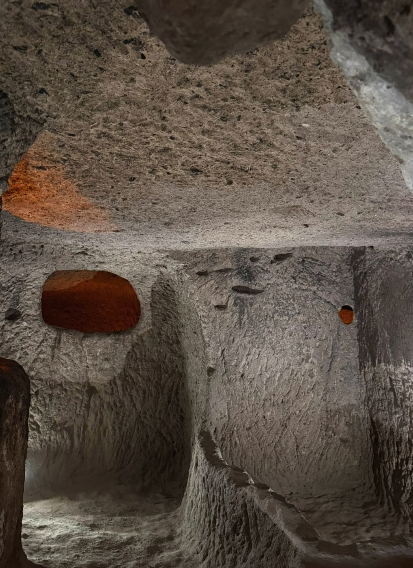
Who Built Derinkuyu? The History of the Underground City
Who built Derinkuyu, and why does a whole city sit 85 metres beneath a quiet Cappadocian town? The honest answer starts with an admission: no one is entirely certain who first dug it. What follows is the story as far as the evidence takes it — and several details that surprise most visitors. For the layout that this history produced, see the Derinkuyu day tours or the architecture page.
The origins are genuinely disputed
One widely cited view credits the Phrygians, an Iron Age people of central Anatolia, with cutting the first chambers around the 8th to 7th century BC. Others argue for different hands and dates. The one thing not in dispute is the rock: the Cappadocian plateau is covered in tuff, a soft stone formed from volcanic ash that can be dug with simple tools and hardens on contact with air. That geology is why the region holds dozens of underground settlements rather than one, and why deep excavation was possible long before modern machinery.
Did you know: The soft volcanic tuff that made Derinkuyu possible is the same rock that forms Cappadocia’s famous fairy chimneys above ground.
Its real heyday was the Byzantine era
Whatever its beginnings, Derinkuyu reached its fullest use in the Byzantine centuries. As Arab–Byzantine warfare swept across Anatolia from the 7th century, the Christian communities of Cappadocia enlarged the underground cities into refuges. When raiders came, whole populations descended with their livestock and stores, sealed the passages behind heavy rolling stone doors, and waited out the danger. Everything about Derinkuyu’s design serves that purpose.
It could shelter around 20,000 people
Estimates put Derinkuyu’s capacity at up to about 20,000 people, along with their animals and provisions — not for a night, but for extended periods. That is the fact that reframes the whole site: this was not a hiding hole but a town that happened to be underground, with stables, kitchens, storage, presses for wine or oil, a school and a church, all carved into the rock.
The engineering is what makes it believable
Two problems decide whether people can survive underground: air and water. Derinkuyu solves both. A network of ventilation shafts — the main one descending around 55 metres — carried fresh air to the deepest rooms, and some of those shafts doubled as wells reaching water that could be drawn from inside and could not be poisoned from above. A sealed city was not a suffocating one.
Did you know: The rolling stone doors could only be moved from the inside — so a sealed level could not simply be pushed open by anyone who broke in.
It stayed in use for centuries
The underground cities were not abandoned after the Byzantine era. Cappadocian Greek communities are recorded using them into the modern period, sheltering during times of unrest as their ancestors had. That long thread ended with the 1923 population exchange between Greece and Turkey, when the region’s Greek-speaking inhabitants left and the cities fell quiet.
It was rediscovered by accident in 1963
Derinkuyu returned to attention in 1963. The most repeated account holds that a resident, renovating a house, broke through a wall into a hidden room and found a passage leading down into the forgotten network. The site was cleared along a safe route and opened to visitors in 1965. Even now, only about a tenth of the full network — the eight open levels — can be visited; the rest remains unexcavated or closed.
It is the deepest, but not the only one
Derinkuyu is the deepest of the Cappadocian underground cities, but there are roughly three dozen across the region. Kaymaklı, about 10 km north, is the best known after Derinkuyu — wider and shallower — and the two are often said to be linked by a long tunnel. All of it sits within the landscape UNESCO inscribed in 1985 as Göreme National Park and the Rock Sites of Cappadocia.
Why Cappadocia is full of underground cities
Derinkuyu is the deepest, but it is far from alone: roughly three dozen underground settlements are known across Cappadocia, and more are still being found. The reason is the same soft tuff that shaped the region above ground. A rock you can dig with hand tools, that firms up as it dries, and that lies in thick, workable layers is close to ideal for excavation — and a region repeatedly caught between empires gave people every reason to dig down. The underground cities are what you get when an easily carved landscape meets centuries of insecurity.
What daily life underground was like
Sheltering at Derinkuyu was not comfortable, but it was survivable, and that was the point. Families brought their animals into the upper stables, cooked in kitchens whose ceilings still carry the soot, drew water from wells sunk inside the city, and slept in rooms carved from the rock. Ventilation shafts kept the air moving; oil lamps sat in niches cut along the passages. People could not stay forever, but they could last through a raid — days or weeks — sealed behind the stone doors while danger passed on the surface above.
The name and the setting
The name Derinkuyu means “deep well” in Turkish — a fitting description for a place defined by its shafts and wells reaching far below the surface. The town that shares the name sits quietly on the plateau today, giving little hint that one of Anatolia’s most remarkable structures runs beneath its streets. That contrast — an ordinary town above, an extraordinary refuge below — is the first thing that strikes many visitors.
What historians still cannot agree on
For all that is known, Derinkuyu keeps its secrets. The date of the earliest excavation is genuinely uncertain, with the Phrygian attribution one argument among several. The full extent of the network is unmeasured, since most of it is unexcavated. Even the famous connecting tunnel to Kaymaklı sits somewhere between local tradition and confirmed fact. That is part of what makes the site compelling: it is old enough, and unrecorded enough, that honest accounts still contain the words “probably” and “thought to be.”
How much of the story is certain
It is fair to ask how much of this can be trusted. The broad shape — a refuge carved over centuries, expanded and used heavily in the Byzantine period, sheltering large numbers behind sealed doors — is well supported. The precise dates, the identity of the first diggers and the full extent of the network are where the honest uncertainty lies. Treat the confident single-sentence origin stories you sometimes read with a little caution; the real history is more interesting for being unfinished. That uncertainty is less a flaw in the record than a reflection of how the site was used: a refuge dug and redug over many centuries by ordinary people, sealed and reopened as danger came and went, was never meant to be documented. Its history survives in the rock itself rather than in any archive, which is exactly why standing inside it matters.
Seeing the history for yourself
Standing at the base of a ventilation shaft or beside a rolling stone door does more than any summary to make this history real. If you are planning a visit, the complete visitor guide covers the practicalities, and the guided Green Tour puts a guide beside you to fill in the story the site itself leaves untold.